
NEWS
LATEST NEWS
- 01Stop Chasing Speed — Build a Better RC Habit
- 02AI Industry Podcast: What We Learned From 2026 Shanghai Low-Altitude Economy Expo
- 03Global market comparison between RC Car,RC Drone and RC Boat
- 04Shenzhen Drone Flight Area Control Rules | Full Guide
- 05Agricultural drone remote control | Professional Plant Protection Transmitter Guide
- 06Application of 2.4G Model Remote Controllers in the Low-Altitude Economy Sector
- 07How to calibrate drone RC controller | Full Step-by-Step Guide
- 08Drone RC Radio Controller: Ultimate Maintenance & Calibration Guide
- 09Edge AI On RC Radio Remotes: What Intelligent Control Will Bring For RC Hobby In Next Two Years
- 010Beginner RC Mistakes: Why Most New Pilots Ignore Radio Remote Calibration

Address:3rd Floor,C1 Buliding,Xiangli Industry Park,Heping Haoye Road,Baoan District,Shenzhen,Guangdong,China.
Zip Code: 518103
Phone: +86 13410681808
E-mail:sale@radiocontrollers.com
NEWS
HOMENEWS
Edge AI On RC Radio Remotes: What Intelligent Control Will Bring For RC Hobby In Next Two Years
2026-09-14 16:40:36 View:3When RC hobbyists upgrade their setups, most attention goes to motors, LiPo batteries and model frames. Yet the core input hardware inside your RC radio remotes — the control logic and onboard processing — is entering a new era powered by edge AI. In the next two years, edge AI embedded directly into transmitters will reshape how pilots control FPV drones, RC cars and scale boats. Many players are confused: what real advantages does edge AI on an RC remote bring? Is this intelligent control just marketing hype, or practical technology worth investing in? This article breaks down technical principles, real-world use cases, limitations and buying outlook for hobby enthusiasts and global bulk buyers.
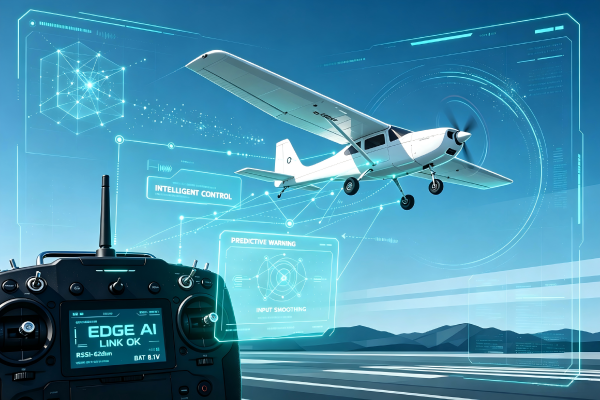
Traditional RC transmitters only send raw stick position signals to receivers. All stabilization, filtering and safety logic lives on the flight controller or ESC of your model. Edge AI changes this paradigm by placing lightweight AI processing chips directly inside your radio remote. The transmitter itself can analyze flight data, user stick habits, environmental noise and signal quality in real time before commands are sent out. Before you place new orders or plan your next remote upgrade, you need to understand both the exciting opportunities and remaining technical hurdles.
Table of Contents
1. What Is Edge AI For RC Radio Remotes
Edge AI means running compact artificial intelligence models locally on the RC transmitter, instead of relying on cloud servers or only the model’s onboard flight controller. The remote’s built-in AI chip processes sensor data, stick input history and telemetry data instantly.
Classic RC radios simply pass joystick signals through to the receiver without interpretation. Edge AI enabled remotes can recognize pilot behavior patterns, automatically filter noisy stick inputs, predict signal loss risks and offer real-time tuning suggestions. All computation happens locally on your radio, so there is no internet connection required during flight.
2. Edge AI Remotes VS Traditional RC Transmitters
Signal Processing
Traditional remotes forward raw stick values directly. Edge AI remotes pre-process inputs, smooth shaky stick movements and filter unintended stick jitter before transmission.
Telemetry Intelligence
Standard radios only display raw telemetry numbers like voltage, RSSI and temperature. Edge AI can analyze trends, predict battery depletion or overheating risks and trigger proactive warnings.
Adaptive Control
Conventional transmitters use fixed exponential and weight settings. Edge AI can adapt control curves automatically based on pilot style, model type, speed and environmental wind conditions.
Hardware & Cost
Edge AI remotes require extra microAI processors, larger memory and upgraded firmware systems. This pushes product cost higher than standard mid-tier transmitters; basic non-AI radios remain affordable for casual users.
3. Real-World Benefits of Edge AI In RC Hobby
For FPV drone pilots, one of the biggest advantages is input smoothing. New pilots often produce shaky stick movements; edge AI can soften jerky inputs without fully overriding manual control, helping beginners learn faster while keeping manual control priority. For RC drift cars, the AI can adjust steering response dynamically at different vehicle speeds for more consistent cornering. For RC boats, the system can detect sudden current interference and stabilize throttle/rudder commands on choppy water.
Another valuable feature is predictive safety alerts. The AI continuously tracks RSSI, link quality and battery drain. It can warn you earlier about potential link dropout risks, giving you extra time to bring your RC drones home before losing control. Advanced versions can also log your flight sessions and generate personalized tuning reports after each flight.
4. Limitations & Risks of Edge AI RC Remotes
First, higher upfront price. Early edge AI transmitters will sit in the premium market segment. Second, AI algorithms add firmware complexity. Bugs or misconfigured AI profiles may interfere with manual control if not engineered carefully.
Some experienced pilots also dislike automated input adjustments. Competitive racers want 100% direct, unmodified stick response. AI smoothing can feel like a lag layer for expert users. Also, local edge AI processing consumes extra power, shortening transmitter battery runtime slightly compared to non-AI radios.
5. Who Will Benefit Most From Edge AI RC Radio Remotes
- New RC pilots learning FPV flight, RC drifting and scale model operation;
- RC training clubs and hobby schools looking for assisted teaching tools;
- Scale hobby users operating expensive large models where early failure warnings reduce crash risks;
- Global B-side buyers sourcing next-generation premium transmitters for product portfolios;
- Pilots who want automated telemetry analysis and post-flight performance logging.
6. Who Can Skip Early-Generation Edge AI Transmitters
- Professional FPV racers who demand zero artificial input filtering and pure manual control;
- Budget-focused casual hobbyists flying only occasionally on weekends;
- Users with fully reliable current transmitters and no need for assisted flight features;
- Pilots who prefer simple firmware and avoid complex, feature-heavy radio systems.
For competitive racing, raw, unaltered stick response remains king. Edge AI assistance may even become a disadvantage for racing. A high-quality traditional or hall-gimbal transmitter is still the better choice for racing pilots.
7. Practical Buying & Sourcing Tips For Edge AI RC Radios
Do not buy purely based on the “Edge AI” marketing label. Verify three core points: manual override priority, ELRS / OpenTX compatibility, and whether AI functions can be fully disabled. A good edge AI remote must let you turn off all intelligent assistance instantly whenever you need pure manual control.
If you are a wholesaler or retailer, note that early edge AI products will have higher prices and longer firmware iteration cycles. Test sample units thoroughly before bulk orders, focusing on latency, power consumption and AI profile reliability.
8. Frequently Asked Questions About Edge AI On RC Remotes
Will edge AI take over control and fly my RC model automatically?
No. The edge AI on RC remotes is designed as an assist tool, not an autopilot. Manual stick commands always stay the highest priority, and AI features can be fully disabled.
Does edge AI on the remote replace flight controller stabilization?
It works alongside the flight controller, not replace it. The remote AI optimizes input signals before transmission, while FC handles onboard stabilization.
Will edge AI increase control latency?
Well-optimized edge AI models add minimal latency. Poorly implemented systems can introduce noticeable lag, so sample testing is critical before purchase.
Can I upgrade my existing RC transmitter to add edge AI?
Not easily. Edge AI requires dedicated processing hardware inside the remote. Most older transmitters lack the chip and memory needed to run local AI models.
Where to source next-generation intelligent RC radio remotes?
rcradioremote.com develops premium RC transmitters, including upcoming edge AI intelligent control models for drone, car and boat hobby markets, supporting both retail and wholesale orders.
To sum up: edge AI built into RC radio remotes is a promising new direction for the RC hobby industry in the next two years. It shines for new learners, scale model pilots and training clubs with its input smoothing, predictive telemetry warnings and automated flight analysis. However, early-generation edge AI radios come with higher costs and firmware risks, and they are not suitable for every pilot. Competitive racers and budget casual users may still prefer classic transmitters. Before upgrading or placing bulk orders, test samples and confirm the AI system can be fully disabled for pure manual operation.
rcradioremote.com supplies professional programmable RC radio remotes and receivers for RC drones, RC cars and RC boats. We carry traditional, hall-gimbal and newly developed edge AI intelligent transmitter options for hobby players and global wholesale customers.
Recommend